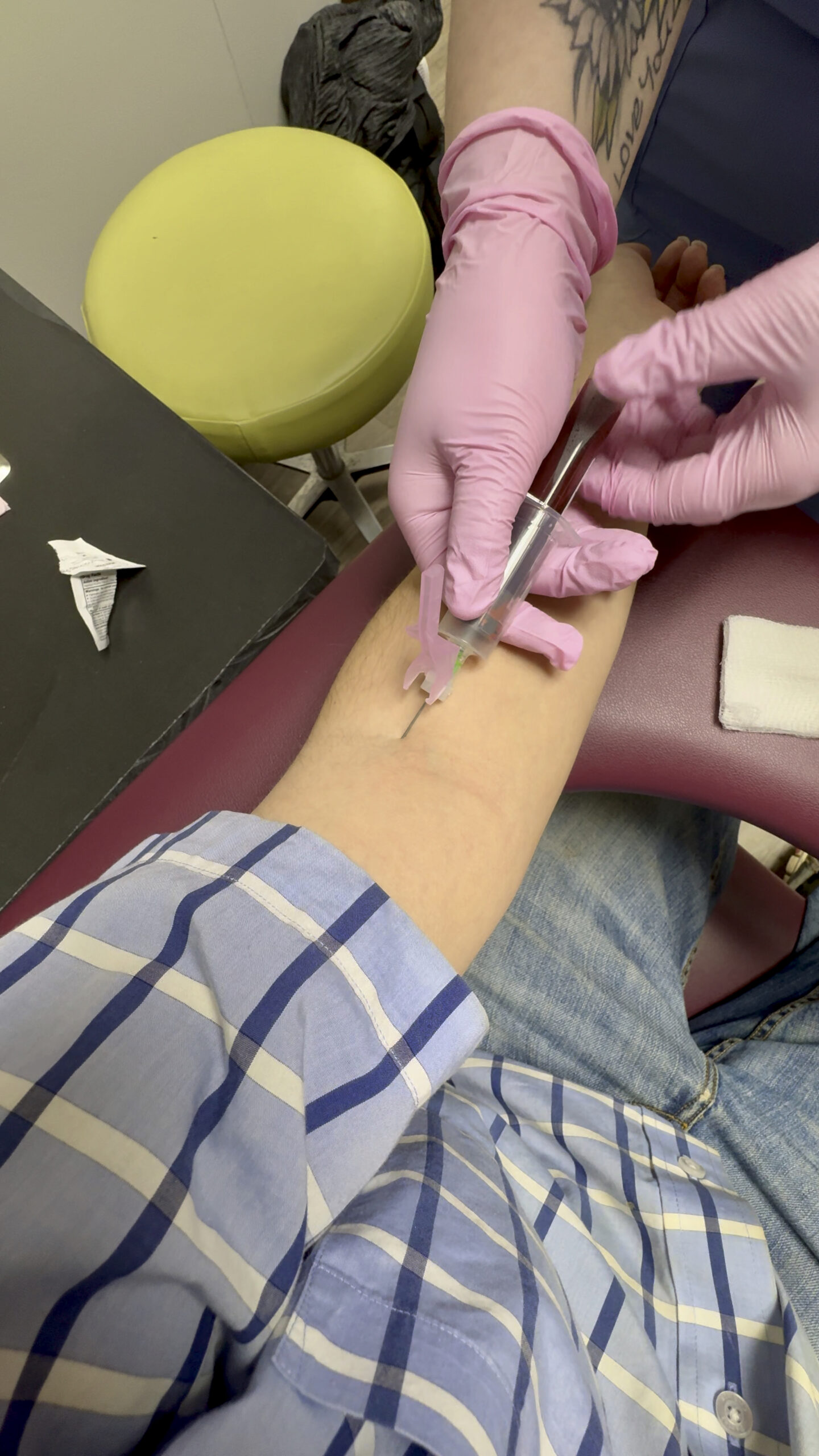
Featured photograph: Harrison Keely / Wikimedia Commons. CC BY 4.0. Cropped where needed for layout. This is an illustrative venipuncture photograph, not a PV treatment session.
Merck KGaA has agreed to buy Silence Therapeutics in a $1.3 billion equity deal. Its main attraction is divesiran, an experimental gene-silencing injection that could reduce the repeated blood-removal procedures used to treat polycythemia vera. Here’s what the trial found, what remains uncertain, and why the competition has already changed.
Every so often, a modern medical story sounds like it belongs in a history book. In 2026, some people with a rare blood cancer still visit a clinic so that a healthcare professional can deliberately remove blood from their bodies. That procedure, called therapeutic phlebotomy, can be repeated when blood-cell levels rise again.
On October 19, a German drugmaker announced a billion-dollar bet on changing that routine. Merck KGaA agreed to acquire Silence Therapeutics, whose leading experimental medicine aims to help patients control excess red blood cells with far fewer phlebotomies.
The connection to ancient bloodletting makes a dramatic headline, but an important clarification comes first: modern therapeutic phlebotomy is evidence-based treatment. It is not a survival of the old theory that removing blood could cure almost any disease. The procedure remains useful precisely because doctors know what it does, when it is needed, and how to measure its effect.
The new question is whether medicine can achieve that effect in a different way—by influencing a hormone that controls how iron reaches the bone marrow.
The Merck–Silence Therapeutics deal at a glance
| Question | Answer |
|---|---|
| Who is buying whom? | Merck KGaA, Darmstadt, Germany, agreed to acquire Silence Therapeutics. |
| What is the deal value? | Approximately $1.3 billion in equity value; $1.1 billion in enterprise value. |
| What is the price? | $20 in cash per American depositary share (ADS). |
| What is the main drug? | Divesiran, an investigational siRNA treatment for phlebotomy-dependent polycythemia vera. |
| What did Phase 2 report? | 88% of divesiran-treated participants met the main response definition, versus 19% on placebo. |
| What happens next? | The parties expect the deal to close in Q1 2027; a Phase 3 divesiran trial is anticipated in the first half of 2027. |
These figures come from the October 19 company announcement and the August 10 Phase 2 announcement.
Why do doctors still remove blood to treat polycythemia vera?
Polycythemia vera (PV) is a chronic blood cancer belonging to a group called myeloproliferative neoplasms. The bone marrow produces too many red blood cells, and may also produce excess white blood cells and platelets. More red cells mean a greater share of the blood consists of cells rather than plasma, which can contribute to circulation problems and dangerous clots.
Doctors therefore pay close attention to hematocrit, the percentage of blood volume occupied by red blood cells. In PV, a widely used goal is to keep hematocrit below 45%. The U.S. National Cancer Institute’s treatment overview says phlebotomy or medicines that reduce blood-cell production can be used to maintain this target, which was supported by a randomized study showing fewer major thrombotic events and cardiovascular deaths with tighter control.
Phlebotomy is direct: a clinician withdraws blood, lowering the amount of circulating red cells. It can be an effective and relatively straightforward treatment, especially when combined with other care selected for a person’s age, clotting history and medical circumstances. It is not necessarily performed at the same frequency for every patient, and it is not the only established treatment for PV.
Still, the burden can add up. A person who needs repeated procedures may have to schedule clinic visits, undergo needle insertions and manage the effects of iron depletion. Some patients are also treated with cytoreductive medicines, which lower cell production rather than simply removing cells already in the bloodstream. An effective therapy that reduces the number of procedures without giving up hematocrit control could matter to both patients and clinicians.
The ancient bloodletting comparison—and where it breaks down
Bloodletting appeared in ancient medicine thousands of years ago and remained popular in many places into the nineteenth century. Physicians once prescribed it for a wide range of illnesses based on ideas about balancing the body’s humors. A historical review published by Clinical Correlations traces that long rise and decline.
Modern therapeutic phlebotomy may resemble the old practice in its physical action, but its scientific reasoning is different. For someone with PV, removing a controlled amount of blood addresses a measurable problem: excess red-cell mass. Clinicians track hematocrit, symptoms and other risks rather than relying on a general belief that taking blood restores balance.
That difference makes the Merck deal interesting, not contradictory. The company is backing a medicine that could reduce the need for a working procedure. The promise is not that doctors finally learned bloodletting was wrong. It is that a useful, sometimes inconvenient intervention may become less necessary for certain patients.
What exactly did Merck buy for $1.3 billion?
The agreement is for all of Silence Therapeutics, a biotechnology company developing treatments based on small interfering RNA, or siRNA. It is an all-cash offer worth approximately $1.3 billion in equity value. The estimated enterprise value is lower, around $1.1 billion, because the two financial measures account for cash and debt differently.
Shareholders are to receive $20 per ADS, with each ADS representing three ordinary shares. The price represents a 130% premium to Silence’s October 16 closing ADS price and an 82% premium to the 30-day volume-weighted average price. Those figures use two different reference prices; they are not conflicting claims. The company expects the transaction to close during the first quarter of 2027, subject to approvals and other conditions. The company’s SEC-filed transaction announcement sets out the terms.
Merck is buying an experimental drug, the wider research pipeline, and the tools and know-how used to design gene-silencing medicines. The principal near-term attraction, though, is divesiran. It is being developed for adults with PV whose hematocrit control requires phlebotomy, a relatively specific patient population with a clear way to measure treatment benefit.
The acquisition also reveals a business calculation. A large pharmaceutical company can sometimes absorb the cost and risk of running late-stage trials more easily than a smaller biotechnology business. That does not make success certain, but it helps explain why promising Phase 2 results can attract buyers before a drug has been approved.
What is divesiran, and how could it replace some blood draws?
Divesiran is an investigational siRNA treatment designed to reduce expression of a gene called TMPRSS6. The gene normally helps control the activity of hepcidin, a hormone made mainly in the liver that regulates the body’s access to iron.
Red blood cells need iron to make hemoglobin, the oxygen-carrying protein inside them. If less iron is available to the bone marrow, it becomes harder for the body to keep producing red blood cells at an excessive rate. Divesiran’s proposed mechanism uses that connection rather than removing red cells after they have already entered circulation.
The TMPRSS6–hepcidin–iron pathway, in plain English
- Divesiran silences TMPRSS6. The drug is designed to reduce production of a protein involved in suppressing hepcidin.
- Hepcidin rises. With less suppression, the body’s natural iron-regulating hormone can increase.
- Less iron reaches the bloodstream and bone marrow. Hepcidin restricts iron absorption and release from stores.
- Red-cell production can decrease. The intended result is better hematocrit control and fewer required phlebotomies.
That is a mechanism of action, not proof of long-term outcomes. The relevant question is whether the drug safely and reliably controls hematocrit in larger studies, and how it compares with available therapies in clinical practice. Silence’s Phase 2 release describes this biological approach.
What did the SANRECO Phase 2 trial actually show?
The pivotal figure behind the deal is 88%, but it needs an explanation. In the randomized, double-blind, placebo-controlled part of the SANRECO Phase 2 trial, 48 phlebotomy-dependent patients with PV received divesiran or placebo over a 36-week study period.
SANRECO PHASE 2 Primary response: no phlebotomy and hematocrit below 45%
Company-reported Phase 2 results; not a Phase 3 outcome or a head-to-head comparison with Mimrylo.For the primary endpoint, a responder had to meet both conditions between weeks 18 and 36: no phlebotomy and hematocrit below 45%. According to the company’s August 2026 topline results, 88% of participants treated with divesiran met that definition, compared with 19% on placebo.
Two schedules were tested. Response rates were 93.8% with treatment every six weeks and 81.3% with treatment every 12 weeks. Over weeks 0–36, patients in the divesiran groups needed an average of 0.2 phlebotomies per patient, versus 2.1 for patients receiving placebo. The company reported p-values below 0.0001 for the primary response and phlebotomy-rate comparisons.
These results are striking because the trial measured something visible in day-to-day care: whether someone could maintain a target blood level without having blood removed. But it was a small study and these are topline company-reported findings, not evidence that the drug prevents strokes, extends life or eliminates phlebotomy for everyone. The study also reported two Grade 1 anemia events considered treatment-related by investigators. The company said no new safety findings emerged, while emphasizing that more testing is needed.
For Phase 3, the planned regimen is every 12 weeks. That spacing is one of the drug’s most attractive features. Yet it is also the schedule with the lower response percentage within this small Phase 2 dataset. Larger studies will have to show how dependable it is across a more diverse patient population.
Watch: A hematologist explains the divesiran trial
For readers who want to hear a specialist discuss the data rather than rely only on a press release, CheckRare has published an interview with Marina Kremyanskaya, MD, PhD, of the Icahn School of Medicine at Mount Sinai. The video covers the SANRECO results and the changing PV treatment landscape.
Video: CheckRare, “Topline Results From the SANRECO Trial Testing Divesiran in Polycythemia Vera.” Watch on YouTube or read the CheckRare page.
The twist: Another treatment is already FDA approved
One important development makes the Merck announcement more complicated than a story about an experimental drug replacing an old procedure. On August 28, 2026, the U.S. Food and Drug Administration approved Mimrylo (rusfertide) for the treatment of erythrocytosis in adults with PV. That means divesiran would enter a market where an iron-pathway medicine already exists, if it eventually wins approval.
Both drugs are connected to hepcidin but use different methods. Mimrylo is a hepcidin mimetic: it imitates the action of the natural hormone. Divesiran is designed to silence TMPRSS6 so the body produces more of its own hepcidin. The FDA’s 2026 approval list confirms Mimrylo’s status, and its prescribing information describes a once-weekly subcutaneous regimen.
| Feature | Divesiran | Mimrylo (rusfertide) |
|---|---|---|
| Status on Oct. 21, 2026 | Investigational; Phase 3 planned | FDA approved in the United States |
| How it works | Silences TMPRSS6 to raise endogenous hepcidin | Mimics hepcidin |
| Dosing | Every 12 weeks proposed for Phase 3 | Weekly, according to U.S. label |
| What is not established? | Phase 3 efficacy, long-term safety and approval | How real-world outcomes compare directly with divesiran |
These are not head-to-head trial results. It would be misleading to compare response percentages from different studies as if the patient populations, endpoints and methods were identical. If divesiran eventually offers similar or better control with injections only four times a year, that could be meaningful. The evidence does not yet show it will.
Why would Merck take the risk before Phase 3?
For pharmaceutical companies, acquisitions often involve paying today for a combination of scientific potential, future sales opportunities, intellectual property and research capacity. Silence has a gene-silencing platform and a wider set of experimental programs, including work on lipoprotein(a) through the candidate zerlasiran. Reuters’ coverage of the acquisition describes those additional pipeline assets.
The unusual part of divesiran is that its commercial story can be framed in an immediately understandable way. It could turn frequent trips for phlebotomy into a less frequent injection schedule for some eligible patients. A patient, clinician or payer does not need to understand RNA interference to grasp why that might be valuable.
Yet trial success alone would not settle the commercial argument. Cost, insurance coverage, adverse effects, monitoring requirements, competition with Mimrylo and other PV therapies, and physician experience all affect adoption. That is why a deal headline is not a prediction of future revenue. Merck is acquiring an opportunity and the risks that come with it.
The hormone was first discovered for a completely different reason
There is a surprising backstory to hepcidin. Researchers first noticed related peptides around 2000–2001 while studying antimicrobial activity. One peptide was named LEAP-1, or liver-expressed antimicrobial peptide. Another research group used the name hepcidin, reflecting its liver origin and apparent ability to kill microbes.
At first, this looked like another discovery about how the body fights infection. Soon, studies connecting hepcidin to iron overload showed that it is also a major regulator of iron movement. A review of hepcidin’s discovery and biological properties describes the transition from antimicrobial peptide to central iron-control hormone.
That discovery matters to this acquisition because it created a new way to think about controlling red-cell production. Instead of simply removing excess blood, scientists could influence the supply of iron needed to make it. The path from a basic research finding to a potential PV medicine took decades and crossed fields that at first appeared unrelated.
RNA interference went from a Nobel Prize to a drug platform
The other half of divesiran’s history dates to 1998, when Andrew Fire and Craig Mello showed that double-stranded RNA could suppress specific gene activity. Their work led to the discovery of RNA interference, or RNAi, and they received the 2006 Nobel Prize in Physiology or Medicine for it. The Nobel Prize announcement explains the mechanism and its importance.
RNAi creates a way to interrupt the messages cells use to make proteins. Designing a sequence is only part of the job: developers also need to protect the RNA, deliver it to the right tissues and demonstrate that changing a target has a clinically useful effect.
It took roughly 20 years from the 1998 discovery for the first siRNA medicine to reach the U.S. market. In August 2018, the FDA approved Onpattro (patisiran) for a rare hereditary disease affecting nerves. The FDA later described that approval as the arrival of a new RNA-based drug class.
Divesiran shows how that approach continues to spread into new indications. Its goal is not to rewrite a patient’s DNA; it is to reduce a particular messenger signal. Whether the target proves clinically valuable enough for approval is what the next trial must answer.
The buyer is not the American Merck
One naming detail matters for readers following the deal from the United States. Merck KGaA of Darmstadt, Germany is not Merck & Co., the American pharmaceutical business commonly called MSD outside the U.S. and Canada.
The two companies share historical roots, but the German company’s U.S. subsidiary was expropriated during World War I in 1917, and the firms have remained separate. In the U.S. and Canada, the German group’s healthcare operation uses the name EMD Serono. Merck KGaA’s official brand-history page explains the distinction.
That may sound like a minor corporate footnote, but accurate naming helps readers understand which company is acquiring the technology, who will be responsible for the program and how to interpret future announcements.
What could prevent divesiran from reaching patients?
The next milestones are straightforward to name and much harder to achieve. First, the acquisition must clear its conditions and close. Second, the planned Phase 3 trial must begin and produce results strong enough to support a regulatory application. Third, regulators must review the full evidence on benefits, adverse effects, manufacturing and other requirements before the drug can be marketed.
A larger trial could find that the encouraging Phase 2 response is smaller in a broader population. It could identify side effects that were too rare to emerge clearly in a 48-person study. It must also show that the proposed every-12-week schedule is sufficient over time. None of these possibilities means divesiran will fail; they explain why an 88% Phase 2 response rate is not the same as an approved treatment.
There is also a wider clinical question. Reducing phlebotomy is valuable, but PV care is about more than the number of blood draws. Doctors also consider clotting risk, symptoms and how the disease progresses. Patients should not stop or change treatment because of an acquisition or an early-stage result. Those decisions belong with their hematologist.
The bigger picture: Medicine is moving upstream
The most memorable contrast in this story is not between old and new medical fashion. It is between two points in the same biological process. Phlebotomy removes excess red cells from the body. Divesiran aims to influence the system that helps determine how many red cells are produced in the first place.
That shift—from managing a downstream consequence to adjusting a molecular pathway—runs through much of contemporary biotechnology. It can produce treatments that are more targeted or convenient, but it can also introduce new risks and unexpected biological effects. Precision alone does not guarantee better outcomes.
For polycythemia vera, the commercial and scientific stakes have become unusually visible. Mimrylo has already established that the iron-regulation pathway can support an approved drug. Merck’s $1.3 billion equity deal shows how much another company is prepared to invest in a different way of targeting that same system.
And the real test will not take place on the day the acquisition closes. It will be whether divesiran eventually helps people keep their hematocrit under control, with fewer burdens and acceptable safety, in the clinical settings where they actually receive care.
Frequently asked questions
What is the Merck–Silence Therapeutics acquisition worth?
It is an all-cash agreement valued at approximately $1.3 billion in equity and $1.1 billion in enterprise value. The offer is $20 for each Silence Therapeutics American depositary share. Source: the acquisition announcement.
What is divesiran?
Divesiran is an investigational siRNA medicine that targets TMPRSS6. It is designed to raise hepcidin levels, limit available iron and help control excess red-blood-cell production in people with polycythemia vera.
Is divesiran approved in 2026?
No. As of October 21, 2026, divesiran remains experimental. A Phase 3 trial is planned for the first half of 2027, and regulatory approval is not guaranteed.
Why is blood removed from patients with polycythemia vera?
Therapeutic phlebotomy lowers the concentration of red blood cells. It helps physicians maintain hematocrit below 45%, an established treatment target associated with a lower risk of major blood clots and cardiovascular death.
Does divesiran mean patients will never need phlebotomy again?
Not necessarily. Phase 2 results showed that many treated patients avoided phlebotomy during a specified part of the study while meeting a hematocrit target. That does not establish lifelong freedom from phlebotomy or suitability for every patient.
How does divesiran compare with Mimrylo?
Mimrylo is an FDA-approved hepcidin-mimicking medicine dosed weekly. Divesiran is an unapproved siRNA therapy designed to increase the body’s own hepcidin; its planned Phase 3 schedule is every 12 weeks. There are no direct head-to-head results establishing which is better.
Which Merck company is buying Silence Therapeutics?
The buyer is Merck KGaA, Darmstadt, Germany, not the separate American company Merck & Co. In the United States and Canada, the German group’s healthcare business operates as EMD Serono.
When might the acquisition and Phase 3 trial happen?
The companies expect the acquisition to close in the first quarter of 2027, subject to conditions. Silence has said the divesiran Phase 3 trial is anticipated to start in the first half of 2027. Both are plans, not completed milestones.
Conclusion
The Merck–Silence Therapeutics acquisition is more than a large biotech transaction. It is a bet that a gene-silencing treatment might reduce one of the most familiar and burdensome procedures used in polycythemia vera care: repeated therapeutic phlebotomy.
Divesiran’s Phase 2 results are promising, and its proposed every-12-week dosing is easy to understand as a potential advantage. But the drug is not approved, the larger Phase 3 evidence is still ahead, and an approved competitor is already on the market. For now, the story is one of scientific possibility—not a finished medical revolution.
Medical disclaimer: This article provides general news and educational information and is not medical advice. Anyone living with polycythemia vera should consult their hematologist before changing treatment.
Reporting date: October 21, 2026. This article reflects publicly available deal and clinical information at that date. Source links are provided throughout. Featured photo is an illustration of blood drawing and does not depict a person being treated for polycythemia vera.